3 October 2026 · 5 minute read
Reflective practice sounds like training-day jargon, but at its heart it is simple: pausing to think honestly about your work with children, so that tomorrow's practice is a little better informed than today's.
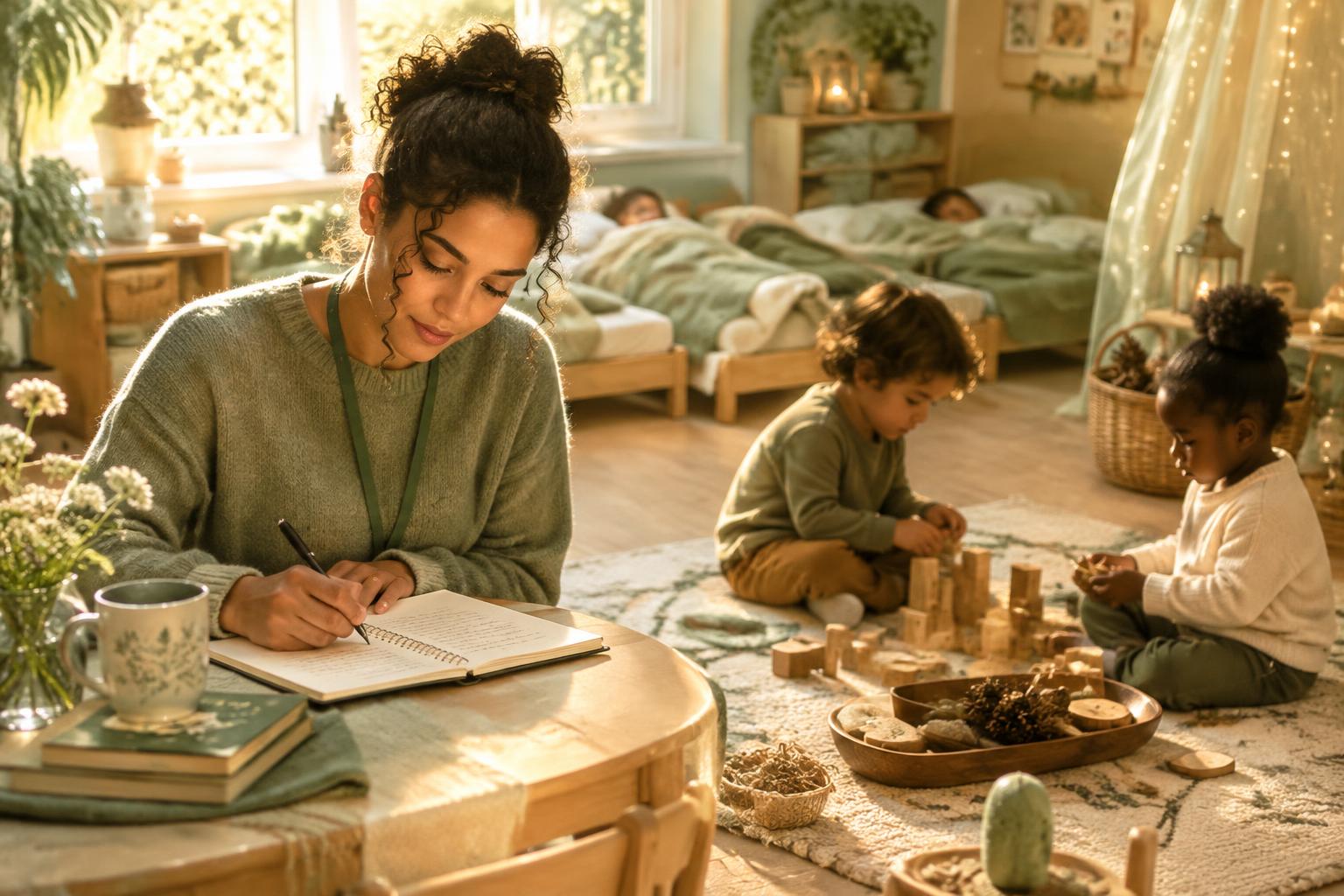
So what is it, really?
Reflective practice is the habit of stepping back from the busy, emotional, unpredictable reality of an early years day and asking yourself what happened, why it happened that way, and what it means for what you do next. It is thinking about your work, not just in it.
Every practitioner already does an informal version of this. You notice a child struggled with the transition from lunch to sleep and wonder why. You try a new way of introducing a song and it lands beautifully — or flops. Reflective practice simply makes that thinking deliberate: written down, talked about, and turned into a decision.
The idea has a long history in professional education — Donald Schön described "reflection-in-action" (thinking while you work) and "reflection-on-action" (thinking after the event), and Graham Gibbs offered a simple cycle of describing, analysing and acting. You don't need to memorise any of it. What matters is the habit, not the theory.
Why it matters
Children change constantly — developmentally, seasonally, one new sibling at a time. Practice that isn't reflected on quietly goes stale: the same activities run each term, the same children dominate, the same assumptions go untested. Reflection is how a setting stays responsive to the children actually in front of it.
For practitioners, reflection is also what turns experience into expertise. Ten years of experience can be one year repeated ten times — or ten years of genuinely different practice, depending on whether the thinking happened in between.
And for teams, a shared reflective habit builds a culture where it is safe to say "that didn't work and here's what I learned". That openness, more than any document, is what makes practice improve over time.
Four questions that do most of the work
You don't need a framework or a form. Ask these four questions about a single moment and you have reflected properly:
What actually happened?
Describe the moment in plain terms: what the child did, what you did, what was said. Not a judgement yet — just an honest account of the event as it unfolded.
Why did it happen that way?
Look beneath the surface. Was the activity too hard, too easy, too long? Was the child tired, hungry, new to the room? Was the environment working against you?
What does it tell you about this child?
What did the moment reveal about what the child knows, enjoys, avoids or is ready for next? This is where reflection connects to what you plan next.
What will you do differently — or the same?
Good reflection ends in a decision: change something, keep something, or try something new tomorrow. A reflection with no next step is just a diary entry.
Making it part of your week
The most common failure of reflective practice is that it becomes a document written for someone else to read. Keep it small, real and useful:
- Keep a small notebook or note on your phone for one-line reflections at the end of a session
- Choose one moment each week to think through properly, rather than trying to reflect on everything
- Use supervision time for a real conversation about practice, not just paperwork and rotas
- Share one 'what I noticed' moment in a team meeting and invite others' perspectives
- Revisit reflections after a few weeks — did the change you decided on actually make a difference?
- Ask a colleague to observe a short moment and describe what they saw; two perspectives beat one
Reflecting together
Individual reflection is valuable; team reflection is transformative, because colleagues see things you can't. Use these prompts in supervision, room meetings or a short practice walk:
Which child did we understand better this week, and what changed because of it?
What did we stop doing, and what happened as a result?
Where are we making assumptions about a child or a routine?
What worked for one child but not for another — and what does that tell us?
What did a parent or carer tell us that we haven't acted on yet?
If we could only change one thing next week, what would it be and why?
A note on recording
Write reflections for yourself and your team, not for an imaginary audience. Record what actually happened and what you decided — and when notes involve individual children, keep them minimal and identifying-free: use initials or your setting's own reference numbers, and include only what is genuinely necessary.
The purpose of a reflection record is to help you see your own practice clearly. A few honest, specific notes you actually revisit are worth far more than a full folder written once and never opened again.
The key question
Does your practice change because of what you learn — or does experience just accumulate?
If your team can point to real decisions that came from real moments — a routine adjusted, a resource reintroduced, an approach changed for one child — reflective practice is already alive in your setting. Keep it that small, that honest and that regular.